4-Way Waste Segregation: An Impossible Goal or a Necessity?
Circular economy
Resource recovery
Sustainable lifestyle
Waste segregation
- By Divya Tiwari, Advisor, Saahas
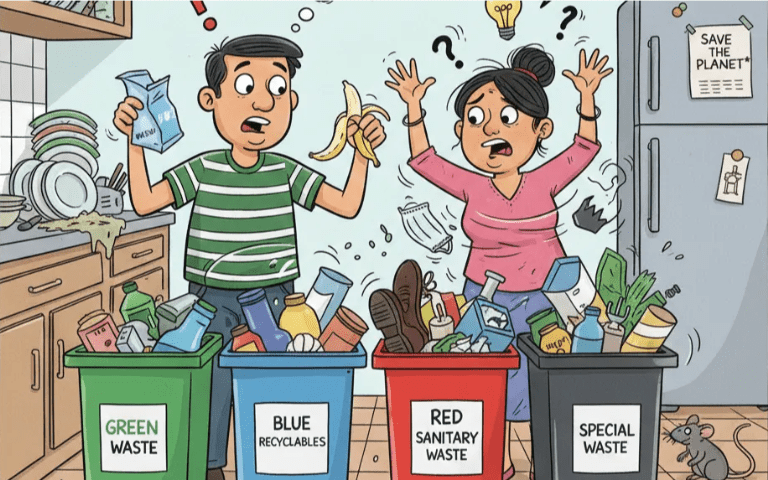
The revised SWM Rules mandate 4-way source segregation. Why should we segregate, and why 4-way?
The most fundamental thing about waste management that everyone must understand is that ‘once mixed, can’t be fixed’. Keeping separate bins is effortless (it just requires some space in your mind and at your premises), while sorting mixed waste is expensive, inefficient and a very dirty job. Machines can do some sorting, but many items are too soiled for resource recovery; washing and drying them is expensive, and the associated costs make many categories economically non-recyclable. Also, to understand how unhygienic handling mixed waste is vs. segregated waste, please visit any waste dump site and compare it to this facility that receives waste from places that segregate. Biodegradable waste, which constitutes about 50% of Municipal waste, is most impacted by mixing. Compost made from mixed waste can only be used for landfilling, while compost made from source-segregated waste serves as a soil conditioner.
Now, why 3/4 way segregation? It’s a simple science, no. of categories are decided based on what is being done with the waste, if it is all going for landfilling, we don’t need to segregate at all. But India is running out of landfill space, so something needs to be done. If we can at least pull out the biggest quantum, the biodegradable waste, that would be the most impactful step, hence green-blue (Organic-Inorganic). Now, India has always had a decent recycling industry, largely informal, but it provides livelihoods to many. So, it was important not to contaminate the Non-Biodegradable with hazardous items such as medical waste and leftover paint. Also, note that much of the downstream sorting is done manually, so mixing items like sanitary pads and diapers is extremely unhygienic, and items like broken glass and nails are quite dangerous for workers to handle. So, such items were to be separated out in the 3rd bin, the red bin. Red bin could also be used for extremely soiled non-biodegradable items like plastic container soiled with oily gravy or if you are very confused about milk packets as it does not fit in the ‘wet/dry’ categorisation, it was better to put it in the red bin instead of contaminating the blue/green due to your confusion or laziness (milk packets are to be rinsed, dried and put in blue bin). As per the latest rules, 3rd bin has been split into red and black. Red is only for sanitary waste and the rest which is called ‘Special Waste Stream’ will go in the black bin. This is because India has many dedicated medical waste incinerators now where the sanitary waste must go while other items like broken glass, paint etc. should not go in these incinerators, it will be subjected to further specialised mechanised sorting.
Now, let us discuss the elephant in the room. Why should I segregate if it is getting mixed by the collector!! But unless the waste is segregated, no one is going to dirty their hands and invest in this industry. Investment in this industry is extremely critical, not just to manage waste but also to recover some fast-depleting resources, not just the rare earth metals, but even our soil needs its nutrients back (more than 50% of arable land is dead). So if u can do your part, the industry will do theirs. Practising segregation is like cycling, once u practice it, you will never unlearn it. Just give some space to the idea in your home (keep the right bins at the right place) and in your mind (understand the logic behind segregation)!
Circular economy
Sustainable lifestyle
- by Suvarna Mishra, Knowledge Development Associate, Saahas
Policy
Resource recovery
Waste segregation
- By Anas Mohammed R, Project Manager, Saahas
Circular economy
Sustainable lifestyle
- By Pausali Pradhan, Knowledge Development Associate, Saahas