Beyond Likes and Shares: Why Bengaluru’s Solid Waste Management Crisis Persists Despite the Social Media Buzz?
Resource recovery
Waste segregation
- By Renuka Angappan, Project Manager, Saahas
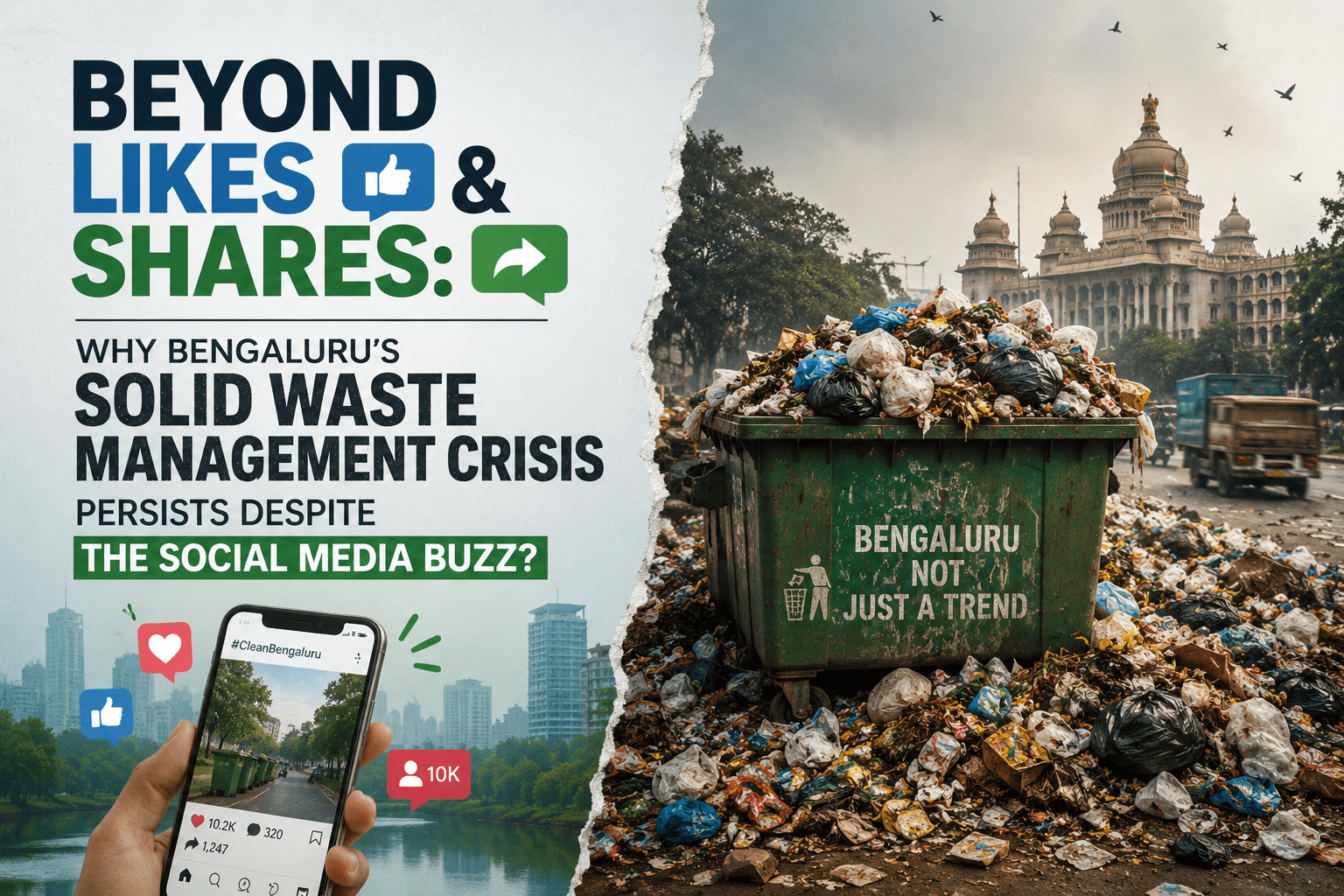
Lately, my social media feeds have been flooded with posts from Bengaluru on tree plantation drives, cleanup campaigns, waste-free events, composting workshops, and passionate appeals to save the environment. The city undoubtedly has a growing community of environmentally conscious citizens who care deeply about sustainability.
Yet, despite all this noise and visibility, Bengaluru continues to struggle with one of its most pressing urban challenges — solid waste management.
So why is solid waste management still failing despite the growing buzz on social media?
Awareness Does Not Always Translate into Action
Social media has made it easy to express concern. A click, a like, a repost, or a comment can instantly signal support for a cause. Participating in an occasional cleanup drive or planting a sapling often provides a sense of contribution and satisfaction.
But sustainability is not about an event. It is not a photograph posted once a year on World Environment Day. It is not a weekend activity undertaken for social validation. Many of Bengaluru’s educated and digitally connected citizens actively engage with sustainability-related content online. Sustainability champions will emerge, gain attention, and eventually fade from public memory. Social media trends will come and go.
However, an uncomfortable question remains: Are we practising sustainability inside our homes with the same enthusiasm that we display on social media?
The true test of environmental responsibility begins at the doorstep, not on a digital platform. Sustainability is a daily practice. It is the conscious decision to segregate waste every single day, reduce consumption, compost at home, and ensure that one’s actions do not burden the environment.
Real sustainability is about doing the right thing even when no one is observing you. It is about segregating waste every morning without expecting recognition. It is about refusing single-use plastics even when it is inconvenient. It is about teaching children that waste is not somebody else’s problem. These actions rarely generate likes or followers. Yet they are the very foundation of a successful waste management system.
When citizens treat sustainability as a personal responsibility rather than a public performance, lasting change becomes possible.
Coming back to the question of the failing solid waste management system, the answer lies in a gap that neither technology nor awareness campaigns alone can bridge — the lack of a genuine connection between the government, the community, and the waste ecosystem itself.
Governments can create policies, deploy infrastructure, appoint contractors, and establish collection systems. However, no municipal authority can successfully manage waste generated by millions of people without active citizen participation. Because the challenge is not merely operational; it is behavioural.
What has often been missing is sustained community engagement. Awareness campaigns tend to be top-down, while behavioural change requires continuous local interaction, education, and relationship-building. Absence of trust has been a bottleneck in Bengaluru’s solid waste management system.
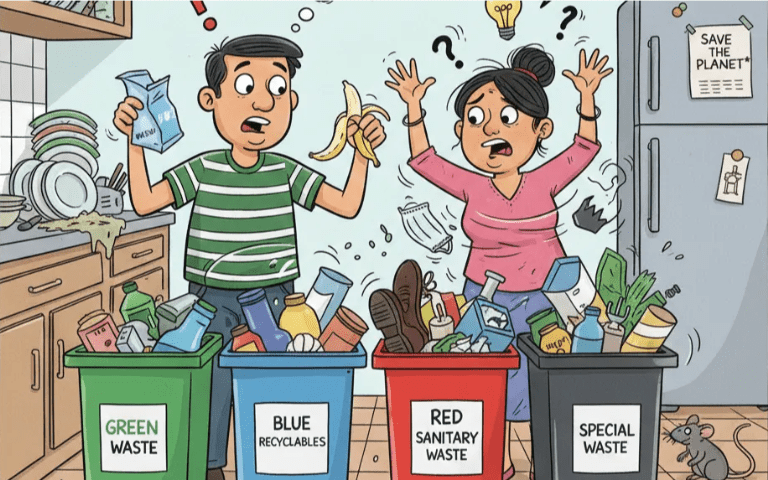
Many residents ask, “Why should I segregate if the waste gets mixed later?” Others question whether their efforts make any meaningful difference.
Citizens need to understand the journey of waste — from their kitchen bins to processing facilities, recyclers, composting centres, and landfills. Only when people understand this journey do they appreciate the importance of source segregation.
Over the years, inconsistent systems, poor communication, and fragmented implementation have weakened public confidence. Citizens often do not understand what happens to waste after collection, where it goes, who handles it, and how segregation creates value. Without this understanding, source segregation becomes just another instruction rather than a meaningful contribution. People are far more likely to participate when they can clearly see the impact of their actions and trust that the system works.
What Bengaluru needs today is not another viral campaign. It needs a citizen movement where awareness turns into action. A movement led by residents, apartment associations, schools, local leaders, volunteers, waste workers, and communities working together at the neighbourhood level.
Citizens must spend time understanding and participating in the waste collection process. They must engage with households, explain source segregation, and help people understand where their waste goes after it leaves their homes.
When residents become educators and ambassadors within their own communities, trust begins to build. When trust builds, participation improves. When participation improves, segregation improves. And when segregation improves, the entire waste management system becomes more effective.
The success of Bengaluru’s waste management journey depends on one important lesson: meaningful change happens when communities, government institutions, and enforcement authorities work together.
A lasting impact is created when all stakeholders in the waste management ecosystem act in coordination. Success is not driven by infrastructure or enforcement alone; it is rooted in a strong civic mindset and shared responsibility. The transformation will begin when every citizen believes that the street outside their home is as much their responsibility as the living room inside it. Only then will Bengaluru move beyond awareness and towards action.
This sense of ownership transforms waste management from a municipal responsibility into a community responsibility. Cleanliness becomes a shared value rather than a government mandate. Cities succeed when citizens become partners in change, not just spectators.
Bengaluru’s waste problem is not fundamentally a waste problem. It is a participation problem. The future of Bengaluru will not be determined by the number of environmental posts shared online. It will be determined by the everyday choices made inside millions of homes across the city.
Circular economy
Sustainable lifestyle
- by Suvarna Mishra, Knowledge Development Associate, Saahas
Circular economy
Resource recovery
Sustainable lifestyle
Waste segregation
- By Divya Tiwari, Advisor, Saahas
Policy
Resource recovery
Waste segregation
- By Anas Mohammed R, Project Manager, Saahas