Unboxing for 30 seconds, on earth for 300 years!
Circular economy
Sustainable lifestyle
- By Pausali Pradhan, Knowledge Development Associate, Saahas
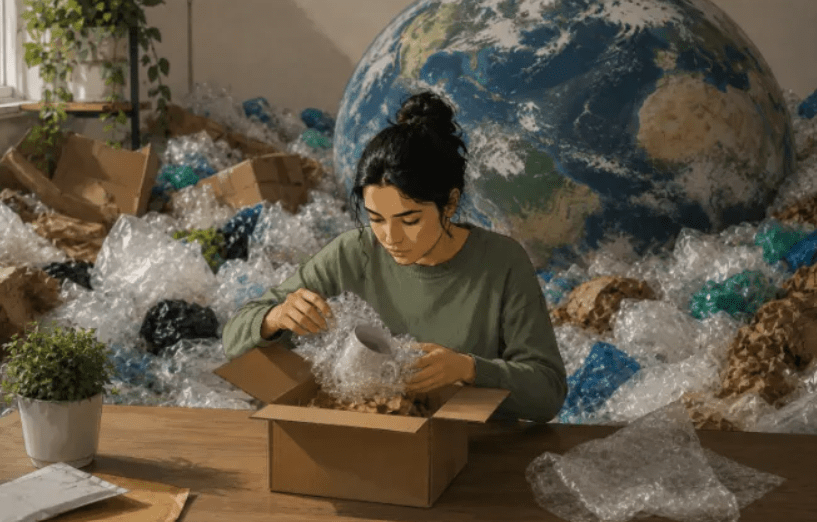
A million views on that unboxing video and a million tonnes in the landfill, and we ignore it, assuming it will go away. But it stays, and it grows, the pile, I mean, not the views! Plastic, cardboard, styrofoam, bubble wrap, or foil — the fancy packaging varies in its forms and sizes. But what stays constant is the fate of our planet under the curse of packaging waste. Research states that packaging accounts for about 40% of the world’s plastic waste. Navigating to India, a country where most households use dry-fruit boxes to store stationery and old calendars turn into book covers, is now buried under the burden of bubble wrap and cardboard boxes. With about 60% of plastic waste originating from packaging, which appears to be ‘a crisis disguised as a wrapper’, it has made its way to every Indian household. Not far behind in the ‘modern all-packed goods’ lifestyle, the per-capita packaging material consumption in India is now 4.3 kg annually. No matter how fancy it seems, every packaging material is short-lived, with a product life ranging from 15 minutes to 16 months. Yet, the post-consumption half-lives span decades or even centuries. In brief, it does not leave the environment. It just adds to landfill height or chokes our water bodies, with only a very small fraction falling into the circular economy. Microplastics from single-use sachets or PFAS from food packets enter our bodies before those packets reach their expiry dates. In this age of fast packaging, it makes us question, time and again, what the solution to this growing crisis of packaging waste could be.
This brings me to reflect on the EU’s new Packaging and Packaging Waste Regulation (PPWR). To address the issue of excess packaging, the empty space in any package would be capped at 50%, and unnecessary packing layers should be avoided. To make packaging materials more sustainable, the regulation recommends using recycled content at varying proportions for each packaging type and also bans certain categories of single-use plastics (SUPs). In India as well, under the Plastic Waste Management rules, producers, importers, and brand owners (PIBOs) now need to comply with extended producer responsibility (EPR) for plastic packaging. This rule obliges PIBOs to meet minimum recycling targets for different categories of plastic packs and to use recycled plastic content in new packaging. In the event of non-fulfilment of obligations, PIBOs would be liable for environmental compensation under the polluter-pays principle. E-commerce giant Amazon now offers an option to club parcels and avoids using a secondary packaging layer for goods already packed by manufacturers. Following this rule, Amazon claims that nearly 50% of Amazon’s goods in India are now delivered with reduced packaging.
While producers have already been made aware of their responsibilities, it is also necessary for consumers to take responsibility for their actions and understand the hidden cost of convenience. One mindful choice at a time or a community-driven leap, as responsible consumers, it stands as our duty to unwrap the crisis of wrappers. Carrying our own containers to parcel food from eateries is not something the EU’s regulations crafted anew; in fact, it has been a practice passed down by our grandmothers. While bringing back this practice, we can also bring back our “multi-purpose endlessly reusable dabbas” instead of resorting to disposable wraps. And going back to these deeply rooted sustainable habits makes me realise that carrying cloth bags to the vegetable market was, in fact, a kind of muscle memory in every household. Nowadays, somewhere beneath the blindfold of compostable plastic carry bags, this memory has long been forgotten. Conscious consumerism can also be practised by bundling online orders to reduce the number of individual packets and by choosing the no-packaging option when available.
Now is the time not merely for awareness but also for conscious actions. With the growth of the FMCG and e-commerce sectors, the culture of fast packaging needs to slow down. With stakes as urgent as microplastics being found in breast milk posing a significant threat to infants, our choices have impacts that stay with our planet forever. To lessen this burden, a transformative path that converges policies and behavioural change is imperative.
Circular economy
Sustainable lifestyle
- by Suvarna Mishra, Knowledge Development Associate, Saahas
Circular economy
Resource recovery
Sustainable lifestyle
Waste segregation
- By Divya Tiwari, Advisor, Saahas
Policy
Resource recovery
Waste segregation
- By Anas Mohammed R, Project Manager, Saahas